Prompting LLMs in the Arabic script is 2x cheaper if you speak Arabic vs. Acehnese.
Tokenizers price language-script pairings, not languages or scripts: evidence from 203 languages and 6 production tokenizers
tokenomics
AI
Suppose you are a Malian programmer, using an LLM to help you write code: the same prompt in Tamasheq, your language, written in a Latin script vs. a Tifinagh will have the same number of characters, yet the Tifinagh script will cost you 5x more tokens. Tifinagh is the traditional writing system used to write the Berber languages of North and West Africa. You quickly rule out the obvious explanations: after all, both prompts are the same length, the content is the same, and one is a Latin transliteration of the other, so they’re the same language. What is left is the tokenizer and the token cost turns out, not to be a property of your script or your language, but of them as a pair. You realize that there wasn’t much text in that language-script combination in the corpus your tokenizer was trained on.
The Arabic script, to use another case that makes this point, is cheaper than the romanized alternative for Arabic speakers. Yet, if you’re an Indonesian who speaks Acehnese, an Austronesian language of northern Sumatra unrelated to Arabic, which uses an Arabic-based script, you may spend nearly twice the token cost compared to an Arabic speaker, despite using the same Arabic script.
This is economically significant because tokens have become the de facto currency of AI. Commercial LLMs use tokens to price their APIs, and retail-facing AI apps use tokens to measure context limits. In both cases, tokenization drives a wedge between nominal metrics and real consumption. For pay-as-you-go developers, variations in token cost based on language/script force non-English queries to pay higher real marginal costs for identical computational work. For flat-fee retail subscribers, the same inefficiency acts as a non-price rationing, where communicating in a non-English language quietly shrinks your working memory and exhausts LLM capacity earlier. So if you have 200,000 tokens for an LLM, what you can do and how long you can work with your LLM vary based on your language and script. A developer pays 5x for the same request and a subscriber’s 200,000-token window is worth about 19,691 tokens because they speak Tamasheq and write in their traditional script.
The data used below comes from FLORES-200, a dataset of 1,012 sentences, professionally translated and aligned across 203 language-script pairs, so semantic content is fixed in how it is constructed. I then tokenized all of it under six production tokenizers and measured each language against an English control-sentence. Unless noted, the figures use o200k, the tokenizer behind GPT-4o.
The same language costs more in one script than the other
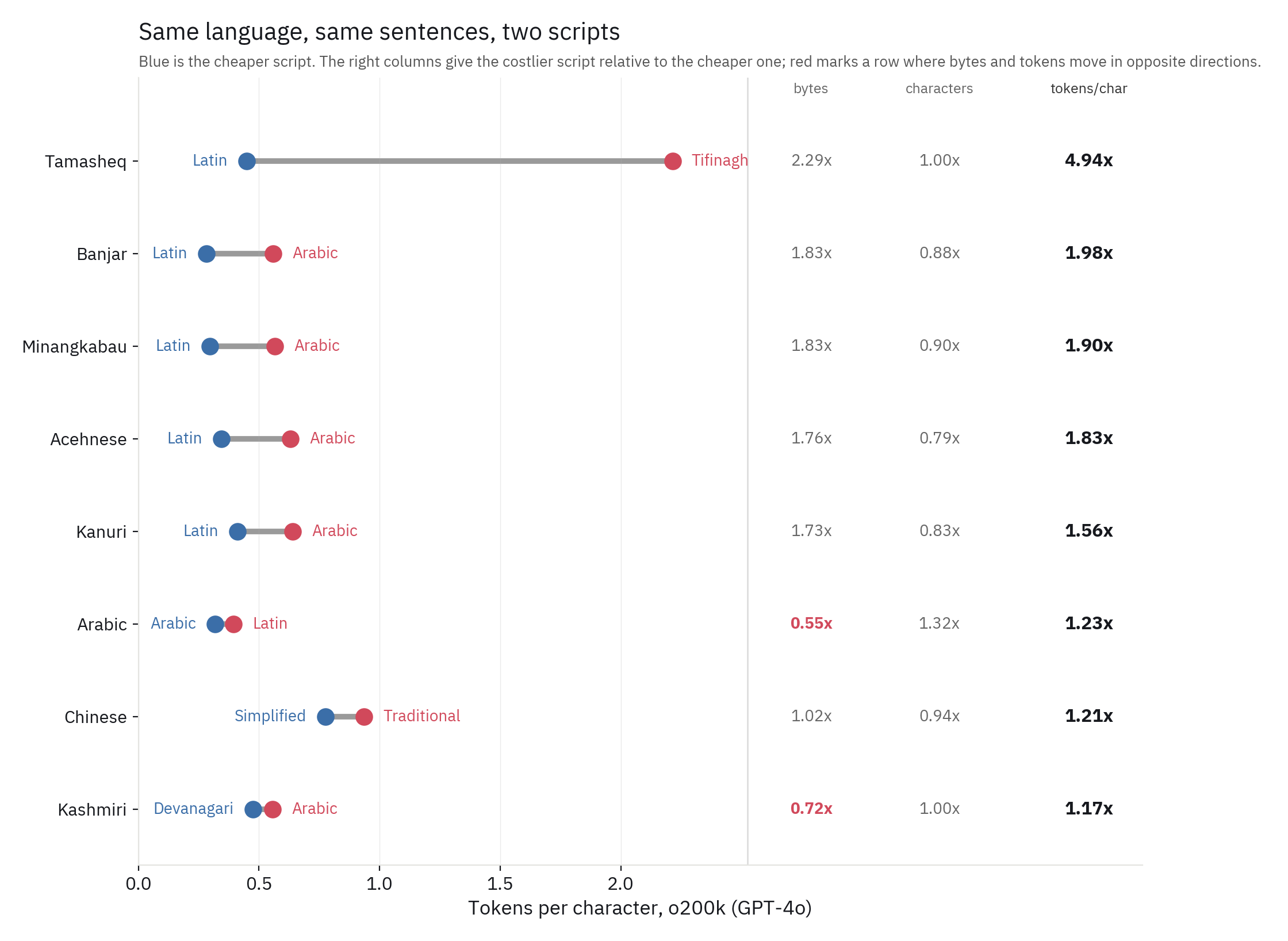
Tamasheq is the cleanest case because both versions of the language are the same text, with nearly identical character counts (0.996 by ratio), yet the Tifinagh version costs 4.94 times as many tokens per character. Since we are considering tokens per character, length is removed from our comparison entirely.
The next obvious objection is encoding: non-Latin scripts need more bytes per character in UTF-8, so perhaps tokens are just tracking bytes. The counterexample to this is how Kashmiri in Devanagari script costs 2.51 bytes per character and 0.475 tokens per character, while in Arabic script, 1.81 bytes and 0.555 tokens. The Devanagari script uses 39% more bytes yet expends 14% fewer tokens per character. So byte width does not explain variation in token cost.
The Malay family gives four independent replications, and they complicate things further:
| Language | Latin (tok/char) | Arabic (tok/char) | Latin (byte/char) | Arabic (byte/char) | Chars (Arab ÷ Latn) | Bytes (Arab ÷ Latn) | Tokens/char (Arab ÷ Latn) |
|---|---|---|---|---|---|---|---|
| Banjar | 0.282 | 0.558 | 1.002 | 1.828 | 0.89x | 1.83x | 1.98x |
| Minangkabau | 0.297 | 0.565 | 1.001 | 1.831 | 0.90x | 1.83x | 1.90x |
| Acehnese | 0.344 | 0.630 | 1.018 | 1.791 | 0.79x | 1.76x | 1.83x |
| Kanuri | 0.411 | 0.640 | 1.055 | 1.822 | 0.84x | 1.73x | 1.56x |
Each Malay language in the Arabic script uses fewer characters (probably because of the Arabic script’s abjad system, where vowels are dropped), yet costs roughly twice the tokens per character. Again, noting that Acehnese and the other Malay languages use the Arabic script but are not linguistically related to Arabic.
However for Arabic, the Arabic script is the cheap option with 0.319 tokens per character, compared to 0.393 for Arabizi, the romanized form that uses digits for consonants. Arabizi can be written entirely with ASCII, one byte per character, the cheapest possible encoding and still costs 23% more per character. Arabic script is cheap for Arabic and nearly twice the cost for Acehnese, an Austronesian language of northern Sumatra with no relation to Arabic beyond a shared writing system.
Byte-pair encoding (BPE) merges over strings, not over scripts. The Arabic-script tokens in o200k are Arabic words, and a merge that learned a common Arabic word does nothing for an Acehnese word that happens to use the same letters. For Acehnese the tokenizer falls back toward character-level segmentation, and the cost roughly doubles. So, what tokenizers are pricing is the language-script pair determined by how much of that pair exists in the training corpus.
The median language isn’t the problem
If we take a step back from language-script pairs to the full distribution, a different trend emerges. Under o200k the median non-English language costs 1.74x English. Unfortunately for Santali speakers who write in Ol Chiki, they can expect to spend 13.79x in tokens, the worst case for o200k. Under GPT-2 the median is 2.55x and the worst, Shan, is 18.70x.
Figure 2 puts every language on the axis as a single dot, with a row for each tokenizer. Two things are visible immediately. Each row has a dense cluster, a floor that nearly every language pays, and then some stragglers out to the right. The floor sits around 1.3x for NLLB and around 2.2x for GPT-2.
Figure 3 is the same data read cumulatively. The x-axis is the token premium, with the height of each curve being the share of that tokenizer’s languages costing at most that much. So a point at (3x, 85%) means that 85% of this tokenizer’s languages cost three times English or less.
What these graphs show is that a better tokenizer does not lower everyone’s premium proportionally. It shrinks the set of languages in the penalty tail. Under GPT-2, 41.4% of languages cost more than 3x English. Under o200k, 7.4%. Under NLLB, 0.0%. Worth noting the trend in the other direction: under mT5 and NLLB a handful of languages cost less than English.
The consequence a consumer feels is that a 200,000-token context window holds about 200,000 tokens’ worth of English content, 33,505 of Tigrinya, 19,691 of Tamasheq in Tifinagh, and 14,506 of Santali. Same subscription, but a ration of one-thirteenth of the capacity for Santali speakers. Similarly, a developer paying per token for an LLM’s API faces a markup. Neither would see a line item in their invoice attributing it to the script they write in.
Doubling the vocabulary helped almost everyone
If allocation is what matters, the next step is to test what happened when a major tokenizer reallocated. Between cl100k and o200k, OpenAI roughly doubled the vocabulary from 100,277 tokens to 200,019. As Figure 4 reflects, 200 of 203 languages got cheaper. On the scatter, nearly every point sits below the diagonal, including most of the worst cases.
Three languages did not benefit from this: Santali went from 12.83x to 13.79x, Tamasheq went from 10.04x to 10.16x, and Tamazight went from 10.07x to 10.21x.
Three cases out of 203 is not a pattern, but the three languages share something: Ol Chiki and Tifinagh have almost no digital corpus. These languages fell outside of every round of vocabulary expansion. So, if vocabulary expansion is not neutral across languages, someone decides where the new tokens go, and the answer follows from what is in the corpus.
Allocation, not size
So how much of the penalty is a budget constraint, and how much is a spending decision?
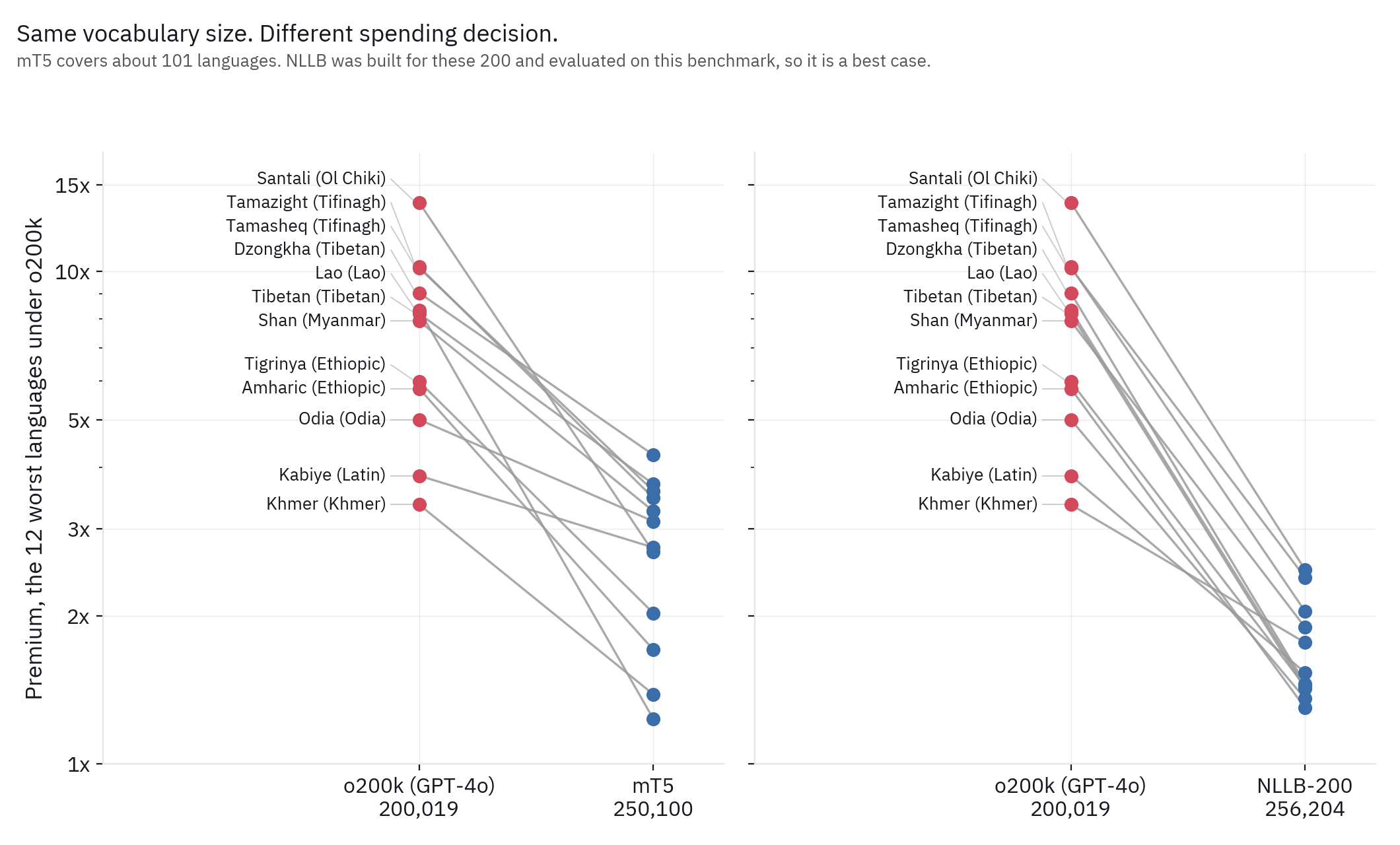
Let’s compare tokenizers of similar size built on different corpora. NLLB carries 256,204 tokens against o200k’s 200,019. Of the twelve worst languages under o200k, the gap is roughly fourfold. Under NLLB, the languages with a premium between 3x and 13x under o200k are now between 1.4x and 2.54x, with the ordering largely preserved.
NLLB is a best case; it was built for exactly these 200 languages and evaluated on this benchmark. mT5 in contrast, covers around 101 languages, 250,100 tokens, and was not built for FLORES-200. Santali drops from 13.79x under o200k to 2.69x and does not appear among mT5’s eight worst languages, which now tops at Dzongkha at 4.24x.
Vocabulary size is functionally a budget, and our token premium is set by how the budget is spent. Corpus composition determines the spending.
What would change this
The fix is known and cheap. A fourfold reduction in the worst-case penalty was possible from a 28% larger vocabulary, and a similarly substantial one was possible at no size increase at all, just a different corpus. This is an allocation decision made by a small number of firms that sets a durable cost and capability differential across populations. Given how transformative LLMs have been and will continue to be, the cost and capability differential could have significant effects on LLM adoption.
I did try to test whether any of this shows up in observed adoption, using Anthropic’s Economic Index, which reports Claude usage by country normalized by working-age population. But the index covers 121 countries whose population-weighted premiums run from 1.0x to 3.4x, with 90% below 1.7x. Every country above 3.4x reports no usage data at all (e.g., Laos at 8.4x, Bhutan at 7.5x, Myanmar, Eritrea).1
The populations paying this cost are not in the rooms where the training corpus is assembled, and they are not in the data afterward.
Footnotes
I relate a population-weighted country premium (FLORES language premiums weighted by CLDR writing-population shares) to the Index’s usage-per-working-age-capita measure across 121 countries. The correlation in logs is r = −0.27, but I would not read it as an estimate of anything. The premium varies at the script level not the country level, and 84 of 121 countries have a Latin-script dominant language. Dominant-script dummies explain roughly half the variation in log premium, and a rough effective-cluster count comes to about two. Also, CLDR’s shares are derived from literacy rates and overstate English use in multilingual countries, so premiums are understated most where the penalty is largest. Ethiopia weights in at 2.8x including English and 3.9x excluding it, against 5.8x for Amharic alone. Separately, Anthropic publishes first-party API usage only as a global aggregate, so the consumer-versus-API comparison that would distinguish a price effect from a capability constraint cannot be run on public data. Code and replication at github.com/aadhavr/token-premium-measurement.↩︎